Trump Threatens 100% Tariff on Any Country That Taxes U.S. Tech Companies — Trade War Warning Rocks Europe

Jubayer Alam
June 27, 2026
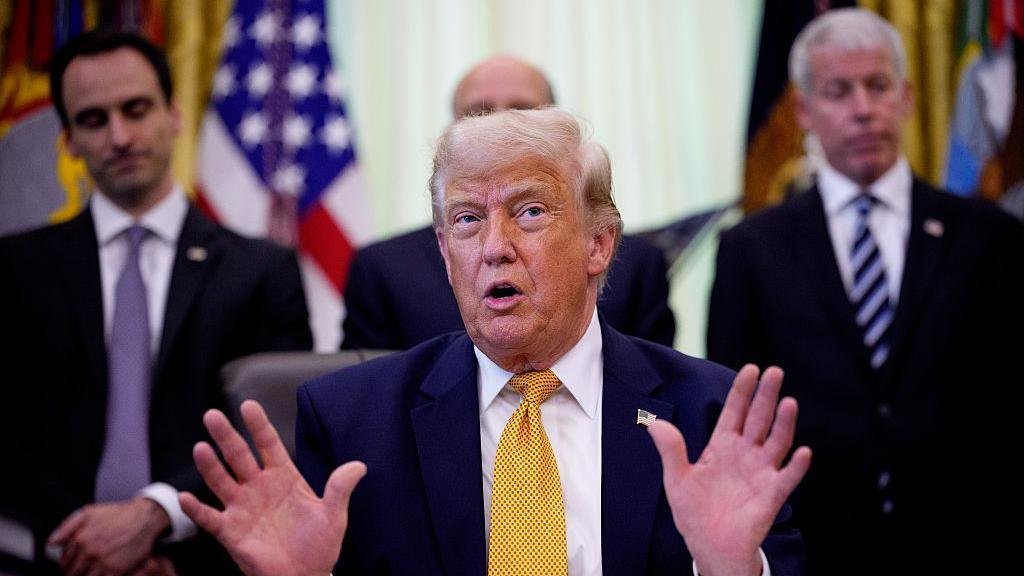
President Donald Trump fired one of his most sweeping trade war threats yet on Friday, June 26, vowing to immediately impose a punishing 100% tariff on all goods exported to the United States from any country that dares to implement a Digital Services Tax on American companies — and warning that the penalty will override any existing trade agreement, signed or otherwise.
The declaration, posted directly to Trump’s Truth Social account and addressed to the entire world, landed like a thunderclap across European capitals, Brussels, and Wall Street alike — injecting fresh uncertainty into a fragile global trading environment less than a week before Trump’s own July 4 deadline for implementing a landmark tariff deal with the European Union.
“Numerous European Countries have been discussing the imminent implementation of a Digital Services Tax on American Companies,” Trump wrote. “Some of these Countries are close to actually doing this. Please let this statement serve to represent that any Country that imposes such a Tax will immediately be met with a 100% TARIFF on any and all Goods sent to the United States of America. This TARIFF will supersede Trade Deals made with the Country, whether implemented, signed, or not. Additionally, the 100% TARIFF will be immediately imposed, if they proceed. Thank you for your attention to this matter. President DONALD J. TRUMP.”
It was a statement that combined the full force of presidential authority, the informality of social media, and the barely contained fury of a president who views foreign efforts to tax American technology companies as nothing short of an economic attack on the United States itself.
What Is a Digital Services Tax — and Why Does It Infuriate Trump?
To understand the scale of Trump’s reaction, it is essential to understand what a Digital Services Tax actually is — and why it has become one of the most persistent flashpoints in the transatlantic trading relationship.
A Digital Services Tax, or DST, is a levy typically imposed on the revenues of large technology companies that operate in a country and generate substantial income from its users, but often do not have a significant physical presence there and therefore pay little or no corporate income tax under traditional rules. The logic behind DSTs is straightforward: as economies have become increasingly digital, the conventional framework for international taxation — which ties a company’s tax liability to its physical location — has allowed global tech giants to book enormous profits in low-tax jurisdictions while conducting most of their actual business elsewhere.
Digital services taxes are typically structured to apply only to the world’s largest and most established technology platforms — principally Meta (Facebook, Instagram, WhatsApp), Alphabet (Google, YouTube), Amazon, and Apple — all of which are headquartered in the United States. According to the Tax Foundation, roughly half of all European OECD member countries have either announced, proposed, or implemented some form of DST. The United Kingdom, for instance, has levied its own 2% digital services tax since 2020, applied to revenue generated by search engines, social media platforms, and online marketplaces that derive value from UK users.
Trump has consistently and vehemently opposed these measures, characterising them as targeted attacks on American business interests dressed up as tax policy. In an August 2025 Truth Social post — one of a string of warnings on the subject — he wrote that digital taxes and regulations “are all designed to harm, or discriminate against, American Technology.” His position is that American tech giants already pay U.S. taxes, and that foreign governments are attempting to extract a second pound of flesh from companies whose dominance they resent but whose services their citizens freely choose and depend upon.
The Threat in Detail: What a 100% Tariff Actually Means
A 100% tariff is not a negotiating nuance — it is an economic sledgehammer. Applied to all goods imported from a country, a 100% tariff would effectively double the cost of every affected product the moment it crossed the U.S. border. For major trading partners like Germany, France, Italy, or the Netherlands, the consequences of such a tariff being imposed would be catastrophic: European car exports, agricultural products, pharmaceuticals, luxury goods, and industrial machinery would all become prohibitively expensive for American buyers overnight.
Trump’s statement went further than a simple tariff threat in one critical respect: he explicitly stated that the 100% levy would “supersede Trade Deals made with the Country, whether implemented, signed, or not.” This is a direct reference to the landmark U.S.-EU trade agreement finalised in May 2026, under which tariffs on most EU exports to the United States are capped at 15%. Trump is telling Europe that if any member state moves ahead with a Digital Services Tax, that hard-won deal is effectively dead — regardless of its legal standing.
The boldness of that claim immediately raised questions among trade lawyers and policy analysts about the legal mechanism Trump would use to make good on the threat. The Supreme Court earlier this year struck down Trump’s sweeping “reciprocal” tariffs — the package that had assigned country-specific rates to nearly every trading partner — finding that the International Emergency Economic Powers Act did not grant the White House such broad unilateral authority. In response, Trump invoked Section 122 of the Trade Act of 1974 to impose a worldwide 10% baseline tariff, though that provision carries a hard ceiling: duties imposed under it expire automatically after 150 days unless Congress votes to extend them.
The U.S. government has previously used Section 301 of the Trade Act of 1974 — a different legal mechanism — to launch investigations into digital services taxes. In 2020, the U.S. Trade Representative launched Section 301 probes into nine EU countries that had adopted or were considering DSTs. But it was not immediately clear which statutory authority Trump was invoking in his Friday post, and whether any unilateral action would survive legal challenge.
Europe Pushes Back — The EU’s Response
The European Commission wasted no time in responding to Trump’s warning, and the tone from Brussels was notably firm.
“Unilateral measures targeting such legitimate policies are unjustified,” said Olof Gill, a spokesperson for the European Commission, on Friday. “If pursued, the EU will respond swiftly and decisively to defend its rights and regulatory autonomy.” Gill defended the taxation of technology companies as “non-discriminatory” and applied equally to “all large companies, regardless of their origin.”
The response encapsulates the fundamental tension at the heart of this dispute. From Brussels’ perspective, digital services taxes are a legitimate exercise of sovereign tax policy — a non-discriminatory, legally defensible response to a genuine structural problem in international taxation. From Washington’s perspective, they are precisely what Trump says they are: an attempt by foreign governments to extract revenue from successful American companies that European regulators and politicians simultaneously depend on and resent.
The European Commission’s warning that it would “respond swiftly and decisively” is not an empty threat. The EU has the tools and the political will to retaliate against U.S. tariffs with counter-measures of its own — targeting American exports that are politically sensitive in key U.S. states, from agricultural products to manufactured goods. A full-scale U.S.-EU trade war triggered by the digital tax dispute would arrive at the worst possible moment for a global economy still recovering from the disruptions of the Iran war and the Strait of Hormuz crisis.
Why Now? The July 4 Deadline and the Bigger Trade Picture
The timing of Trump’s warning is no coincidence. It came less than a week before Trump’s self-imposed July 4 deadline for the United States and the European Union to begin implementing the trade deal that caps most EU tariffs at 15%. That deal, finalised in May 2026 after months of internal EU debate following European Commission President Ursula von der Leyen‘s tentative agreement at Trump’s Scottish golf course last year, explicitly excluded digital services taxes from its scope.
The omission was deliberate at the time — digital taxes were simply too contentious to resolve alongside the broader tariff framework — but it left a live grenade in the agreement. Trump’s Friday warning is a clear signal that he has no intention of allowing European governments to exploit the gap between the trade deal and the unresolved digital tax question. By threatening to tear up the entire 15% cap agreement if any country moves ahead with a DST, he is using the deal itself as leverage to keep European governments in line on the one issue the deal did not address.
For European governments, the pressure is acute. Several EU member states have been seriously considering implementing or expanding digital services taxes as a domestic revenue measure, particularly as their economies face fiscal pressures. But the spectre of a 100% tariff — and the economic devastation it would unleash on export-dependent industries — creates a powerful deterrent.
The precedent here is instructive. Last year, Trump threatened to sever all trade talks with Canada over its own 3% digital services tax. Ottawa subsequently scrapped the levy shortly before it was set to come into effect. The Canada precedent is exactly the outcome Trump is trying to replicate on a far larger scale with Europe.
Who Stands to Gain: Big Tech’s Invisible Fingerprints
Trump’s staunch defence of American technology companies from foreign taxes is, at one level, a straightforward expression of economic nationalism: American companies should not be taxed by foreign governments for services they provide to those governments’ citizens. But it is also a reflection of the enormous political and economic influence that Big Tech wields in Washington.
Digital services taxes, by design, fall almost exclusively on the largest and most entrenched technology platforms — Meta, Alphabet, Amazon, and Apple chief among them. These are not generic American companies caught in a trade dispute; they are the world’s most valuable corporations, collectively representing trillions of dollars in market capitalisation and employing hundreds of thousands of Americans. Their opposition to DSTs is total, vocal, and well-funded. Their interest in having the United States government fight their tax battles at the highest diplomatic level is self-evident.
The overlap between Trump’s trade policy posture and the interests of American Big Tech has been a consistent feature of his second administration. Whether this represents a principled position on the rules of international taxation or a more transactional political arrangement is a question that European regulators and trade experts — including those at the OECD — have been asking for years, and that the events of Friday only sharpened.
What Happens Next: The Road to July 4
All eyes now turn to the July 4 deadline and the governments of Europe’s major economies as they calculate their next move.
The most likely immediate response is a period of careful silence from the countries most exposed — Germany, France, Italy, the Netherlands — as their governments assess the credibility of Trump’s threat against the legal and economic feasibility of his follow-through. The Supreme Court‘s earlier ruling on reciprocal tariffs has created genuine legal uncertainty about whether Trump can deliver on a 100% country-specific tariff without congressional authorisation, and European governments will seek expert opinion on that question before making any public commitment.
For the European Commission, the challenge is to signal resolve without triggering an escalation that neither side actually wants. The EU’s stated willingness to “respond swiftly and decisively” to any U.S. tariffs is real — but Brussels is also acutely aware that a full-scale trans-Atlantic trade war would inflict enormous damage on economies that are already struggling with the global aftershocks of the Iran conflict.
For Trump, the goal is deterrence rather than action: he wants European governments to back away from digital services taxes without the United States having to actually impose the 100% tariff and deal with the political and legal fallout that would follow. Whether Europe blinks — as Canada did — or holds its ground will define the next chapter of one of the most consequential trade disputes of the modern era.
Key Facts at a Glance
- Date of threat: Friday, June 26, 2026 — posted on Trump’s Truth Social account
- The threat: 100% tariff on all goods from any country that imposes a Digital Services Tax on U.S. companies
- Target: “Numerous European Countries” considering or close to implementing a DST
- Trade deal at risk: The May 2026 U.S.-EU trade agreement capping EU tariffs at 15% — Trump says the 100% tariff will supersede any such deals
- July 4 deadline: The date by which the U.S. and EU are meant to begin implementing the 15% tariff deal
- EU response: European Commission called the threat “unjustified” and warned of a “swift and decisive” retaliation
- Legal question: Supreme Court struck down Trump’s previous sweeping tariffs; the legal basis for this new threat is unclear
- Precedent: Canada scrapped its own 3% DST in 2025 after Trump threatened to end trade talks entirely
- Companies most affected by DSTs: Meta, Alphabet/Google, Amazon, Apple — all U.S.-headquartered
What Is a Digital Services Tax? A Simple Explainer
A Digital Services Tax (DST) is a levy placed on the gross revenues of large tech companies that provide digital services — such as online advertising, social media platforms, cloud computing, and online marketplaces — in a given country. Unlike corporate income taxes, which are based on profits, DSTs are based on revenue generated from users in a specific jurisdiction.
They are designed to ensure that global technology giants pay tax in the countries where they earn income from users, not just in the low-tax jurisdictions where they legally domicile their profits. Proponents argue they correct a fundamental flaw in the international tax system. Critics — including the U.S. Trade Representative — argue they unfairly single out American companies and constitute a form of economic discrimination.
More than a dozen countries worldwide have now implemented some version of a DST. The UK’s 2% levy, France’s 3% tax, and various proposed or enacted schemes across the EU are the most prominent examples. The conflict between these national tax policies and U.S. trade policy has been one of the most persistent and unresolved tensions in the global economic order — and, as of June 28, 2026, it is now more explosive than ever.
Further Reading
- CBS News: Trump vows immediate 100% tariff if countries levy digital services tax
- PBS NewsHour: Trump threatens 100% tax on European imports over digital services
- Euronews: Trump threatens 100% tariffs if Europe implements digital services tax
- France 24: Trump threatens 100% tariffs on Europe over digital services tax
- CNBC: Trump threatens 100% tariffs on countries putting digital services tax on American companies
- Bloomberg: Trump Vows 100% Tariff on Countries Over Digital Services Taxes
- Tax Foundation: Digital Services Taxes — Global Research
- OECD: Digital Economy Taxation
- U.S. Trade Representative: Section 301 Investigations
Breaking News Today provides live, verified coverage of global politics, trade, and business news. Follow us for updates as this story develops ahead of the July 4 deadline.



More