Spain Migration Crisis: Troops Deployed After Thousands Breach Ceuta Border

Md.Moshail Ahmed
August 2, 2026
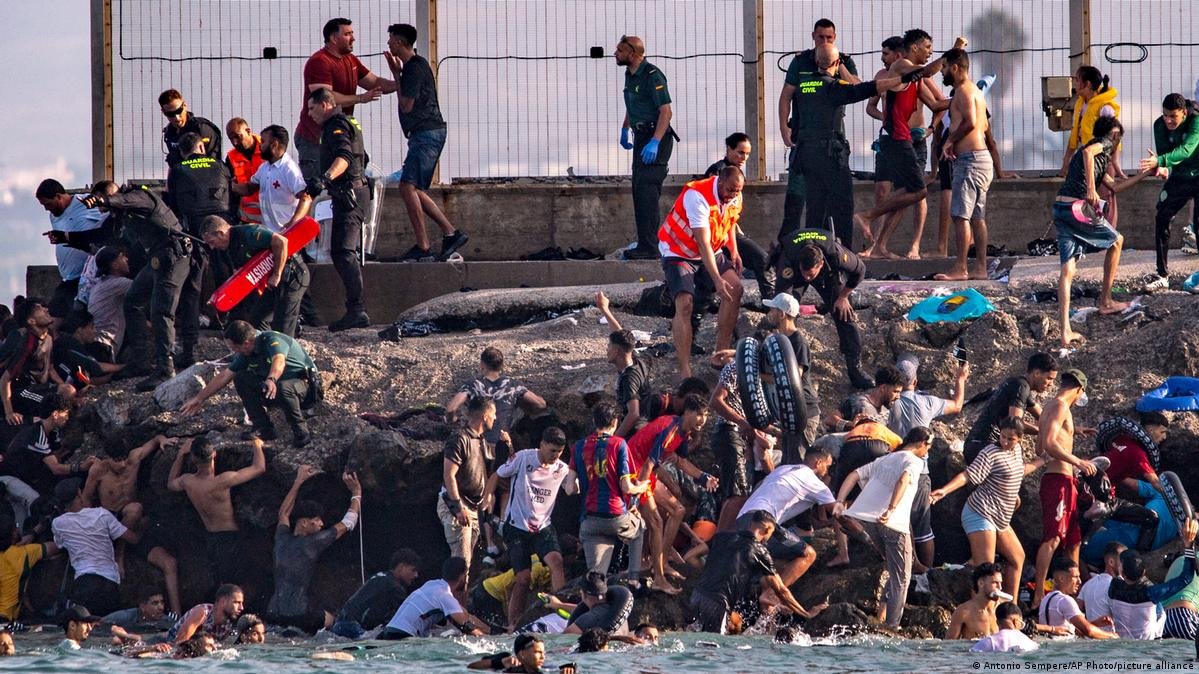
The Spain migration crisis reached a breaking point in late July 2026, when an estimated 60,000 people crossed the border from Morocco into the Spanish autonomous city of Ceuta. This massive and sudden surge overwhelmed local reception facilities, triggering a severe humanitarian and political emergency. The central government in Madrid swiftly deployed military reinforcements to the territory to restore order. (For more context on European border management, explore our Global Border Security Analysis internal reports).
Triggering the Spain Migration Crisis: Border Chaos and Fatalities
The sheer volume of people attempting the crossing transformed the enclave overnight. The incident saw massive crowds, predominantly young men from Morocco, swimming around the Tarajal and Benzú breakwaters or crossing on foot along the shoreline. Some migrants also utilized flotation devices to navigate the sea, while others scaled high border fences.
Tragically, by August 2, at least 72 people were reported to have died, mostly associated with attempts to cross by sea. The influx, which occurred rapidly over the course of roughly 24 hours, overwhelmed Ceuta, a city with a population of about 85,000.
To stabilize the collapsing border, Spain’s Interior Ministry announced the deployment of 60 members of the armed forces alongside an additional 30 Guardia Civil officers.
“The situation is absolute chaos. It’s not possible to give precise numbers, but there are thousands of migrants crossing… the border has totally collapsed.”
— Rachid Sbihi, head of the association representing Spain’s Civil Guard officers, quoted byThe Guardian.
Root Causes of the Ceuta Border Breach
Analysts and local authorities point to a combination of legal misunderstandings and coordinated movements that fueled this iteration of the Spain migration crisis.
Ceuta Migration Crisis Drivers
(Key Factors Behind the Mass Border Breach)
↓
Legal Misinterpretations
(Smuggling networks exploited a recent Spanish Supreme Court ruling on sea returns)
↓
Mass Digital Mobilization
(Sustained irregular entries organized and encouraged along the coastline)
Spain’s Interior Ministry indicated that migrant smuggling networks deliberately exploited a recent Spanish Supreme Court ruling, which affected the special border rejection regime for sea arrivals, to encourage the crossings. Additionally, humanitarian organizations noted that sea crossings had already been gradually increasing in the months prior to this massive explosion of arrivals.
Political Fallout and Mass Returns in the Spain Migration Crisis
The fallout from the breach has reverberated across Spain and the broader European Union. During a visit to Ceuta, Spanish Prime Minister Pedro Sánchez condemned the border breach, describing it as “a violation of Spain’s territorial integrity”. Furthermore, the latest arrivals sparked international diplomatic tensions, with Italian officials calling for Spain to be suspended from the EU’s visa-free Schengen travel zone.
Despite the chaotic initial breach, Spanish officials quickly initiated mass returns. By July 31, the Spanish Interior Ministry confirmed that roughly 50,000 people had voluntarily returned to Morocco, with more departing by the hour.
| Indicator | Crisis Impact Details |
| Total Influx | An estimated 60,000 migrants crossed into Ceuta. |
| Casualties | At least 72 individuals died, primarily drowning in the sea. |
| Expulsions / Returns | Around 50,000 migrants returned to Morocco by July 31. |
| Border Deployments | 60 armed forces members and 30 Guardia Civil officers deployed. |
Sources
- Wikipedia – 2026 Morocco–Spain border incident
- The Guardian – Spain sends extra troops and police to Ceuta after thousands of migrants arrive
- The Guardian – At least 57 people die as tens of thousands cross to Spanish enclave of Ceuta from Morocco
- The Quint – 18 Killed as Thousands Breach Border Between Morocco & Spanish Enclave of Ceuta
- Associated Press – Tens of thousands of migrants voluntarily leave after crossing into Spanish territory of Ceuta
- CBS News – Spain deploys military to Ceuta after thousands of migrant crossings at Morocco border; at least 34 dead


More