Typhoon Bavi Weakens After Landfall in Eastern China; Nearly 2 Million Evacuated

Aderson Aiden
July 12, 2026
Typhoon Bavi slammed into eastern China late Saturday night, bringing torrential rains and destructive winds that forced authorities to evacuate nearly two million people. The powerful storm made landfall in Zhejiang province, prompting massive emergency responses across multiple cities, including the capital, Beijing. Although meteorologists report that the storm has begun to weaken as it moves further inland, the threat of severe flooding and devastating landslides keeps emergency teams on high alert.
The storm marks the second major typhoon to strike the Chinese mainland in just over a week, following closely on the heels of Typhoon Maysak. The rapid succession of these extreme weather events severely tests the nation’s disaster preparedness and infrastructure resilience. Across the Asia-Pacific region, Bavi left a trail of destruction, claiming lives in the Philippines and causing widespread injuries and structural damage in Taiwan and Japan.
The Landfall and Immediate Impact
Typhoon Bavi officially churned ashore at Yuhuan City, a coastal municipality in Zhejiang Province, at approximately 11:20 p.m. on Saturday. China’s National Meteorological Center recorded maximum sustained winds reaching 40 meters per second, or roughly 144 kilometers per hour, near the storm’s center. These wind speeds classify the storm as the equivalent of a Category 1 hurricane on the Saffir-Simpson scale.
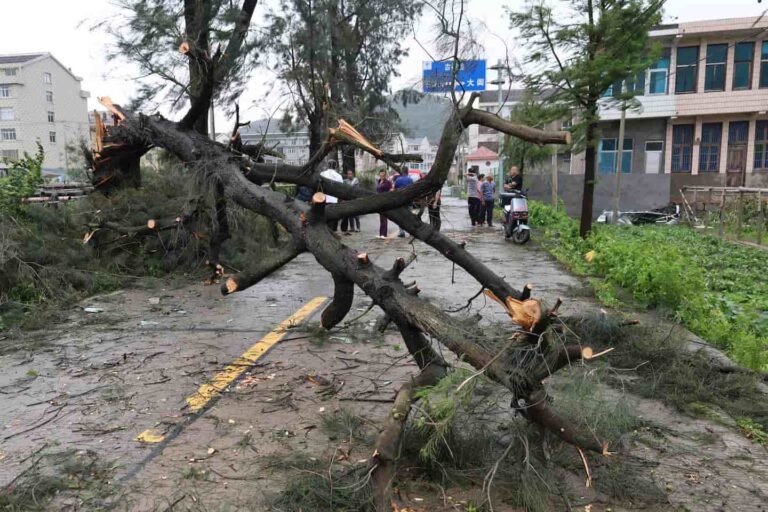
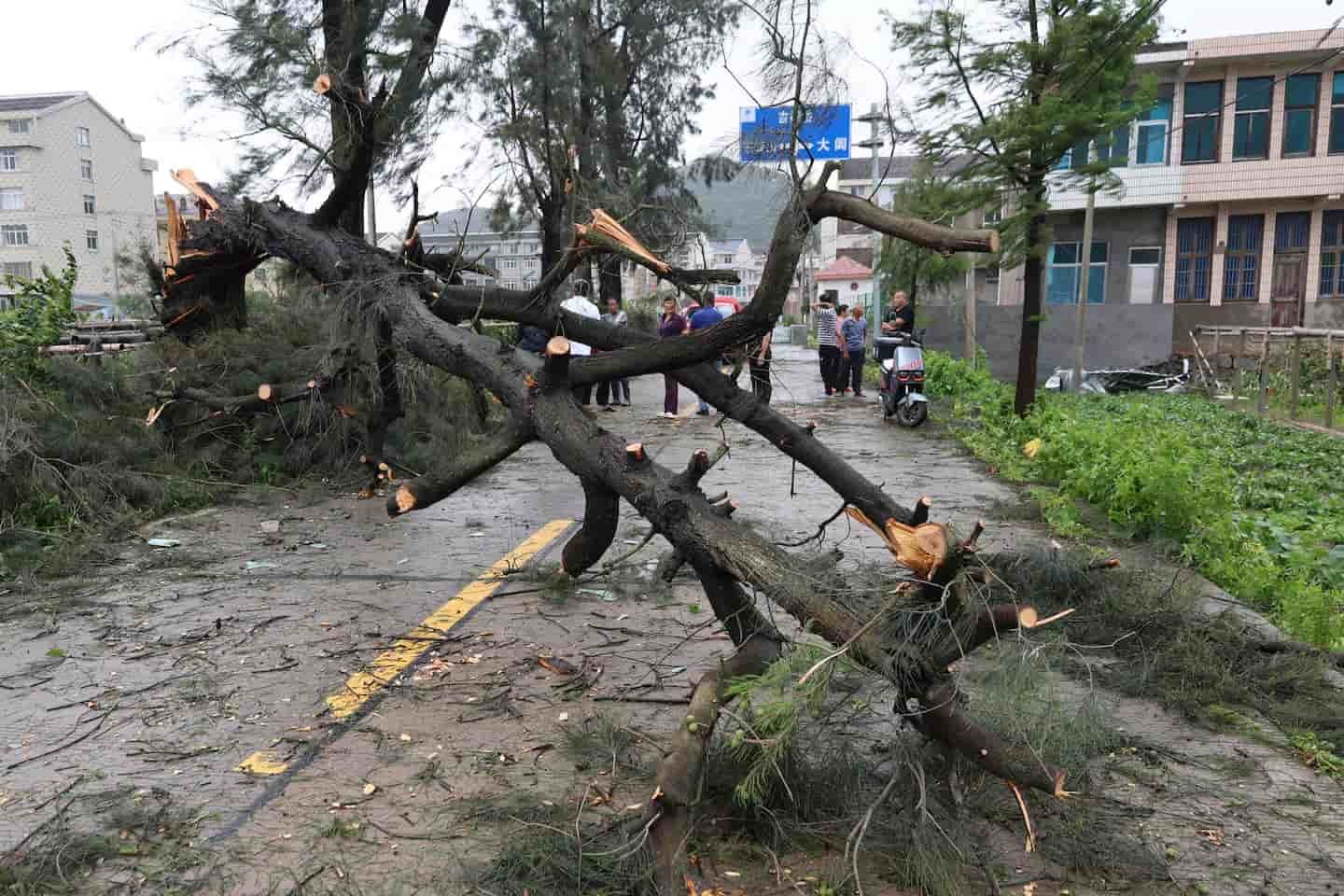
As the storm hit the coastline, it unleashed immense waves that battered sea walls and coastal infrastructure. The ferocious winds uprooted more than 1,300 trees in the neighboring coastal city of Yueqing alone. Local broadcasters aired dramatic footage of emergency workers clearing massive tree trunks from flooded streets while blinding sheets of rain drastically reduced visibility.
Before the typhoon struck, China’s National Meteorological Center issued an orange alert for the typhoon—the second-highest level in the country’s four-tier warning system. Concurrently, the center issued a red alert for rainstorms, signaling the highest possible level of danger for severe precipitation. Meteorologists warned that the storm system would drench large swaths of the country, including Zhejiang, northern Fujian, northeastern Jiangxi, southern Anhui, and parts of Beijing and Hebei, well into Sunday afternoon.
Following the initial landfall, the storm system began tracking northwestward, pushing deep into the province of Anhui. While the friction of the landmass sapped the storm’s wind energy, stripping it of its typhoon status and downgrading it to a tropical storm, the system continues to carry immense volumes of moisture. Forecasters warn that this slow-moving deluge poses a severe risk of flash flooding in inland valleys and urban centers.
Massive Evacuations and Relocation Efforts
Anticipating the storm’s wrath, Chinese authorities executed one of the largest mass evacuation operations of the year. Emergency management teams successfully relocated nearly two million vulnerable residents out of the typhoon’s direct path.
In Zhejiang Province, the epicenter of the storm’s impact, officials moved more than 1.7 million people to safety. Local governments converted schools, community centers, and sports stadiums into temporary shelters, outfitting them with camp beds, emergency food rations, and medical supplies. In Wenzhou, a major city near the landfall zone, authorities targeted the evacuations on coastal residents, dock workers, and people living in aging structures that could collapse under the storm’s force. Shop owners spent the days leading up to the storm reinforcing their storefronts, nailing wooden planks over glass windows, and securing heavy metal shutters to prevent wind damage.
The evacuation efforts extended far beyond Zhejiang. In the neighboring province of Fujian, disaster management teams relocated over 180,000 residents from low-lying coastal areas and mountainous regions prone to mudslides. Further north, the financial hub of Shanghai evacuated approximately 34,000 people from high-risk zones.
Residents largely cooperated with the mandatory evacuation orders. Many communities have grown accustomed to the severe summer weather patterns, relying on strict government protocols to survive the typhoons that routinely lash the eastern seaboard. Emergency personnel, including more than 17,000 rescue workers placed on standby in Fujian alone, stood ready to conduct swift water rescues and clear blocked evacuation routes.
Severe Transportation and Infrastructure Disruptions
Typhoon Bavi brought the region’s vast transportation network to a grinding halt. The intense winds and blinding rain made travel inherently dangerous, prompting officials to suspend services across multiple sectors.
Aviation authorities canceled hundreds of inbound and outbound flights across eastern China. In Shanghai, officials expected airlines to cancel approximately 653 flights at Pudong International Airport and Hongqiao International Airport. Carriers like China Southern Airlines and Spring Airlines preemptively grounded dozens of aircraft to protect passengers and crew.
Maritime operations also suffered total suspensions. Port authorities ordered all commercial shipping vessels, fishing boats, and passenger ferries to return to harbor and drop anchor. The suspension of ferry services effectively cut off several coastal islands from the mainland, though local authorities had stockpiled emergency supplies in advance.
On land, railway operators halted numerous high-speed train services traversing the eastern corridors. Commuters faced closed stations and severe delays as engineers inspected tracks for debris and flood damage. Urban transit systems in cities like Wenzhou and Taizhou reduced bus services, urging residents to shelter in place and avoid any unnecessary travel.
The tourism sector took a significant hit during what is typically a busy summer weekend. Shanghai closed or altered the operating hours of more than 50 major tourist attractions. Authorities padlocked parks, outdoor museums, and scenic waterfront areas to prevent tourists from wandering into dangerous, wind-swept locations.
Wide-Ranging Emergency Responses
The sheer scale of Typhoon Bavi required a synchronized emergency response spanning several provinces. Recognizing the severe threat of inland flooding, nine districts in Beijing activated a Level-I emergency response—the highest level of flood control. The Beijing Meteorological Observatory forecast torrential downpours for suburban districts, including Fangshan, Pinggu, Miyun, Huairou, and Mentougou.
To support the massive local efforts, the central Chinese government quickly mobilized financial resources. The Ministry of Emergency Management and the Ministry of Finance jointly allocated 40 million yuan (approximately $5.9 million) in central natural disaster relief funds. These funds will directly support typhoon prevention, emergency rescue operations, and subsequent rebuilding efforts in Zhejiang and Fujian provinces.
Utility companies deployed thousands of technicians to monitor the electrical grid and repair downed power lines. Despite the fierce winds uprooting trees and damaging utility poles, repair crews worked around the clock in relatively safer areas to restore electricity to darkened neighborhoods. Water management authorities systematically released water from over-capacity reservoirs ahead of the storm to prevent catastrophic dam failures during the anticipated deluge.
International Devastation and Casualties
Before unleashing its fury on mainland China, Typhoon Bavi carved a deadly path across the Asia-Pacific region. The storm system intensified seasonal monsoon rains in the Philippines, resulting in tragic loss of life.
Philippine disaster management officials reported at least 17 fatalities, primarily caused by devastating landslides triggered by the relentless rain. In the southern province of Sarangani, a massive landslide struck a village in the coastal town of Malapatan before dawn, crushing homes under tons of mud and rock. Rescue workers recovered the bodies of 10 villagers, while search efforts continued for three others listed as missing. Another landslide in Lanao del Sur province claimed five lives. In Bukidnon province, raging floodwaters swept away and drowned two individuals. Due to the intense weather, the Philippine government moved roughly 11,000 residents into 77 emergency shelters across the southern provinces.
Following its deadly impact in the Philippines, the storm skirted past Taiwan and Japan’s southern islands. In Taiwan, the typhoon did not make direct landfall but still generated fierce winds and heavy rainfall. Authorities reported at least 113 injuries across the island. Many of the injuries occurred when strong wind gusts blew motorcycle riders off slick, rain-soaked roads. The Taiwanese government suspended schools and offices in most regions and evacuated over 14,200 people from vulnerable areas, including the eastern county of Hualien and the central city of Taichung.
In Japan, local authorities in the southern prefecture of Okinawa issued urgent warnings for high waves, storm surges, and destructive winds. Airlines canceled more than 200 flights across the region as the severe weather battered islands like Ishigaki.
The Climate Change Context
Meteorologists and climate scientists note that Typhoon Bavi fits into a broader, troubling pattern of increasingly intense weather events. China, possessing the world’s second-largest economy and a heavily populated, highly developed eastern coastline, faces growing exposure to destructive storms.
Experts attribute the increased frequency and severity of these typhoons partly to the effects of global climate change. Warmer ocean surface temperatures provide the necessary fuel for tropical cyclones to intensify rapidly. Furthermore, the anticipated emergence of the El Niño weather pattern this year raises significant concerns. El Niño conditions typically disrupt global weather systems, potentially driving up regional temperatures and fueling more intense, moisture-laden typhoons in the Asia-Pacific basin.
The fact that Bavi arrived just over a week after Typhoon Maysak highlights the compounding nature of these natural disasters. Repeated strikes leave the ground supersaturated, rendering landscapes highly susceptible to landslides and flash floods even when subsequent storms carry less wind force. They also strain national emergency response resources and complicate recovery efforts for affected communities.
Ongoing Vigilance and Recovery
While Typhoon Bavi continues to weaken as it tracks further northwestward over land, the danger remains acute. Authorities strictly advise residents to remain indoors and avoid floodwaters, which can conceal hidden dangers like open manholes, sharp debris, and electrified utility lines.
Emergency management departments have transitioned their focus from preparation to active rescue and damage assessment. Helicopters and drones will survey the affected coastal and mountainous regions to identify isolated communities and deploy targeted relief.
Local governments face the immediate task of clearing roadways, restoring critical infrastructure, and ensuring the safety of drinking water supplies. For the nearly two million displaced residents, the coming days will dictate when they can safely leave the temporary shelters and return to assess the damage to their homes and businesses.
Typhoon Bavi serves as a stark reminder of nature’s sheer power and the critical importance of robust, coordinated disaster preparedness. As the storm system finally dissipates over the Chinese interior, the region begins the arduous process of cleaning up, rebuilding, and bracing for whatever the turbulent typhoon season may deliver next.
Sources
- The Independent: Nearly 3 million people evacuated as Typhoon Bavi batters eastern China
- The Indian Express: Typhoon Bavi hits China: 2 million evacuated as year’s ‘strongest storm’ strikes
- PBS NewsHour: Typhoon Bavi makes landfall in eastern China as more than 1 million are evacuated
- LiveMint: Typhoon Bavi hits eastern China, forces 2 million evacuations; some high-speed rail services halted, flights cancelled
- The Times of India: Typhoon Bavi makes landfall in eastern China, over 1 million evacuated
- China Daily: Bavi weakens, but impact to be severe
- Global Times: Severe typhoon Bavi triggers orange alert as authorities in China’s affected regions step up precautions with some flight, train services suspended